⚠️ Disclaimer: You are viewing an Archived Portfolio.
You’re viewing work from my early career [2015] - [2021]. To see my most recent work check out my latest work here →
Re:Fresh
Collaborative Design Project
Smell
An intensive graduate studio design project completed over 17 weeks.Teams were comprised of professionals with diverse specialties including engineers, designers, and subject matter experts.
The site was designed with the core values of sustainability and usability in mind. Integral theory was used as a framework to guide our work. It includes an emphasis on the user experience both individually and collectively. The design was theoretical and meant to simulate what real projects are like.

The Challenge

My teams goal was to take a site at 4th and Lombard St. in Philadelphia and to design a culinary school with a farm to table themed restaurant. Design decisions needed to be informed by in-depth research and fulfill the four perspectives of integral theory. One of these quadrants centers on design excellence for the user's experience.
Deliverables for this project included:
-
Guiding principles
-
Site inventory & analysis
-
Case studies/benchmarking
-
Space programming
-
Competitive analysis
-
Relationship diagrams
-
Sketching, wireframing
-
Project workbook
-
Three design workshops
-
3D prototyping
-
Energy calculations (EUI)
-
Floor plans, elevations
-
Cross sections
-
Financial analysis
-
Interviews
-
Content strategy
Introductions

Before diving into the project, I spent time getting to know my new team members. I joined as an individual with skills in sustainable design, research, and the user experience. My core team members included:
Mohammad Alshenaifi - Architect
Josie Wang - Landscape/Interior Architect
Prerana Appineni - Interior Architect
I was optimistic about the project because not only was everyone incredibly talented, we all genuinely enjoyed each other's company.
Site Visit
We started off by visiting our target site at 401 Lombard St. The current building there is called the "Old Pine Community Center." We took some photos to capture the look and feel of the space. Physically being at the site helped me to understand the context of the space. We saw that there was an old cemetery behind the building and we took note of some possible design opportunities and challenges.
Opportunities
-
Attractive historic views
-
1st floor fireplace and views to cemetery are an asset
-
large flexible spaces and big front yard to utilize
Challenges
-
Low ceiling height
-
Some bathrooms blocking south face
-
Lack of elevator and rigid stair placement
-
Fire safety concerns - ceilings too low for sprinklers


Research
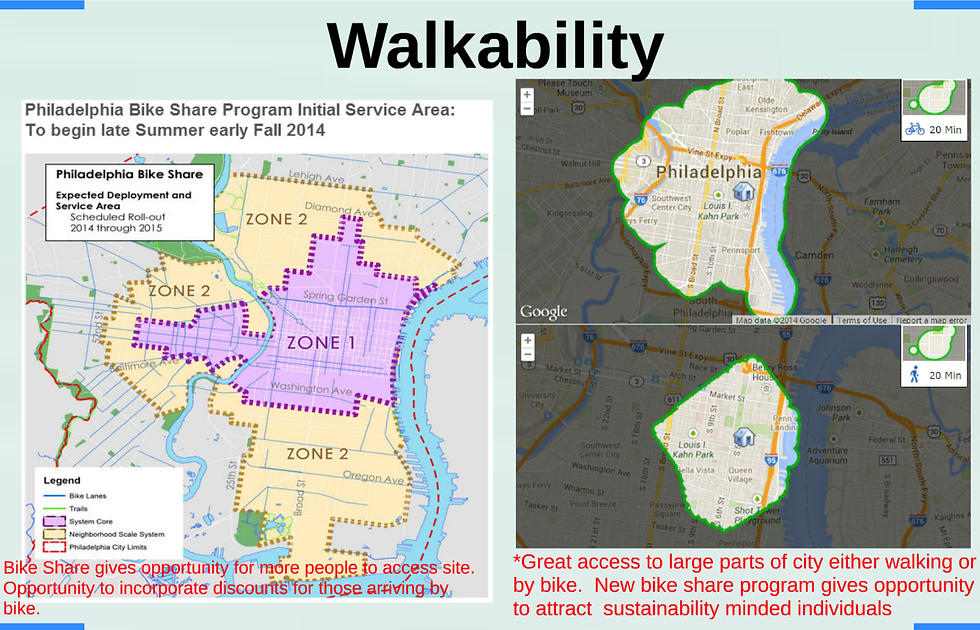
After visiting the site, my team and I dedicated time to sift through a sea of research including 20 comprehensive city reports to understand the current context. We used secondary sources as well as primary research methods through interviewing. We collected data on demographics, transit, fresh food access,and walkability. The results are highlighted here.
You can view the comprehensive project workbook in the appendix.


Site Analysis


Our research gave us the information we needed to thoroughly analyze the site's conditions, assets, and architectural resources.
We performed the following:
-
Site Analysis
-
Site Inventory
-
Architectural Analysis
-
Site Material Analysis
-
Transportation Analysis
-
Climate Analysis
Competitive Analysis & Heuristic Evaluation
Case Studies
We chose four case studies with as a team/ We reviewed what we thought they did well and evaluated the projects based on universal design standards. The four sites were:
-
Uncommon Ground
-
Jungers Culinary Institute
-
Pallotta Teamworks
-
Metropolitan Community College
We drew some design inspirations from these projects. We knew that we wanted to grow food on-site, have many points of interaction, and create a unique design aesthetic for the classrooms and offices. We would later iterate on these ideas along with stakeholders in the design process.


Benchmarking
We then measured each building's performance in terms of energy usage intensity or EUI and the cost per square foot. We used these figures to come up with a benchmark to reach for our design project. My team and I started to brainstorm different strategies to reach these goals including passive conditioning of spaces and waste heat recovery systems.
We developed three target goals for our building's performance.
-
Divert at least 95% of waste
-
Obtain "Champion Status" with the Sustainable Restaurant Association rating system and LEED Gold status
-
Achieve at least 50% energy savings compared to case study benchmarks


Content Strategy
Programming & Space Planning
At this stage, we needed to develop a strategy for how each space was going to be used and design it in a way that focused on enhancing the user experience but also complied with current building codes. Josie and Prerana had the most experience with surveying this information and they taught me about how to create bubble diagrams, a criteria matrix, and ways to estimate the amount of square feet needed for each room.
We were able to sketch out some visual ways to represent how to organize the rooms and identified how close they should be to each other based on the strength of their relationship. We made several iterations on how to organize the spaces and what each should be designated for.


Guiding Principles

The next phase of the project involved creating guiding principles to use throughout our design. We conducted a interdisciplinary design charrette to rapidly develop ideas.
A "charrette" is a design thinking process where all the stakeholders meet to create a solution. We included people from different backgrounds and including the user and we used their feedback to quickly iterate new ideas.
We conducted dot voting as a group to see which ideas were strongest.
We worked to identify key ecological, economic, socio-cultural, and experiential goals for the project. We wanted to have a high performing building that enhanced the user experience.
Sketch, Wireframe, Iterate, Repeat
Our group synthesized our research and the feedback we received from stakeholders. We also invited all of them to join us as we made continual sketches and prototypes for the next few weeks, making sure to gain consensus on all design decisions.
We conducted several more design charrettes throughout our iteration period and used the ideas to improve on our original sketches. It was interesting to see how our concept evolved over time. We started off with an idea to use shipping containers as modular spaces for the building but after hearing feedback from the users and the other stakeholders, we modified the approach.
We were able to preserve the unique shape of the facade from the containers with the building envelope. We listened to the user's thoughts and designed small niche spaces in the front yard so that the user could experience nature.


Focused Research
The next phase of the project involved each person on the team to take a deeper dive into a specific topic for our design. We then came back together and compiled all of our work and made further iterations before producing our final product.
I was responsible for developing a system for on-site food production through the use of aquaponics and comparing the carbon footprint of local vs. conventional food miles. I also decided to use GIS to make a more robust analysis of transportation energy

Food Supply Chain
My goal was to review a complete ecology of food with a focus on waste cycles and aquaponics. The research included
-
Interviews with 12 experts
-
Carbon footprint of the food system
-
Systems Thinking
-
Johns Hopkins food system curriculum
-
EPA and UN publications
-
Research articles and academic studies
-
Online documents and media resources
-
GIS analysis of environmental impacts
I presented the results of the research through an animated video below. You can view the GIS maps to the right.


Final Presentation
All of our work was compiled and printed on a plotter with 36" x 48" sheets. We pinned up the sheets and had a final review with all of the stakeholders to get their feedback. The final project included:
-
Site plans
-
Site sections
-
Elevations
-
Floor plans
-
3D perspective images
-
System diagrams
-
Energy calculations
-
Architectural details
-
Food system analysis
-
Space planning
-
Site programming
-
Cost analysis and sample menu
-
3D walkthrough of the restaurant
-
Daylighting summer & winter


Summer daylight simulation

Winter daylight simulation

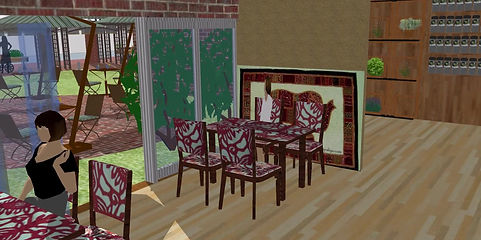
3D Restaurant Walkthrough
Conclusions
My research on the food supply chain proved to be useful to one of the experts involved in the studio. I worked with Shannon Kaplan from the engineering firm, "In Posse" to develop signage on food miles for a project of theirs. Their final design is to the right.
The studio got me really interested in design thinking and I co-led a community charrette to develop ideas for a public park in Roxborough. Click the links below to read more.
Community members imagine a different future for Gorgas Park

Visions for Gorgas Park Gateway
I also pursued training with facilitating design charrettes and workshops. I was awarded a scholarship along with a colleague of mine to get a certification from the National Charrette Institute in Portland, OR.