⚠️ Disclaimer: You are viewing an Archived Portfolio.
You’re viewing work from my early career [2015] - [2021]. To see my most recent work check out my latest work here →
User Research: Graduate Thesis
A graduate level thesis for the M.S. in Sustainable Design degree at Philadelphia University. It studies how the principles of gamification can enhance sustainability. The project reviews research on motivation as it relates to sustainable behaviors. I designed a game to get students on the campus of Philadelphia University to practice composting.

Ideation
I chose this thesis topic because I noticed how negative some of the messaging for sustainability was. Climate change is a serious issue but I knew that guilt and shame were poor motivators. I wanted to study how motivation and behavior interact.
My goal was to make the user experience for sustainable action more enjoyable and as effortless as possible. I looked at how I could leverage gamification to possibly make sustainability fun.
This project was done over the course of a year as a graduate level thesis report. I completed the work individually and my design was evaluated by a panel of expert faculty.
Project deliverables included:
-
Original thesis with Exigence, Problem Explanation, Problem Evaluation, Solution, and Conclusion
-
Primary research through IRB approved survey and interviews
-
Secondary research synthesis
-
Case studies and competitive analysis
-
Design Charrette Workshop
-
Design sketches
-
Prototype of game platform
-
Project plan proposal including scope, constraints, timeline, budget, testing strategies, and evaluation plan
-
Final thesis presentation
-
Thesis defense with panel of experts

Concept Iterations
The first step I took with my thesis was to develop an original idea. The initial phase of the project involved me mapping out the ideas I had and narrowing down the topic to something that was both manageable and innovative.
I determined that my main interest was in the role of motivation and getting people to compost by focusing on the user's enjoyment in the process. I laid out the skeleton of my thesis and set out a research plan. I would iterate on the plan through time.
I initially wanted to make a business model and limit my survey to members of a community composting group. I changed directions and decided to convert the business model to a gamified platform and expanded the audience to university students. I also limited my scope and made a note that detailed GIS maps could enhance the project's evaluation.
Research: Interviews
I began my research by seeking out as many experts I could find to learn about content related to composting, urban food production, and gamification. I had a combination of site visits, phone calls, and email exchanges with people who were willing to help me gather information. I was able to have 16 conversations about the project. I visited several including:
-
Philly Urban Creators
-
Urban Tree Connection
-
Philly Earth
-
Compost Coop


Research: Secondary
I spent time organizing my notes and went through a collection of secondary sources. I concentrated on peer reviewed articles and studies. I read through ten full books, went through informational videos, and completed a Coursera class on Gamification taught by Dr. Kevin Werbach of the University of Pennsylvania. I also spent some time volunteering at the Compost Coop to understand more about composting. In this time, I identified some key subject matter experts and case studies including:
-
Jennifer Mastalerz: Compost Coop
-
Luke Keller: Hello Compost
-
Jane McGonigal: Alternate Reality Games (ARGs)
 Loading Earth Tub |  Earth Tub |
|---|---|
 Adding food waste | 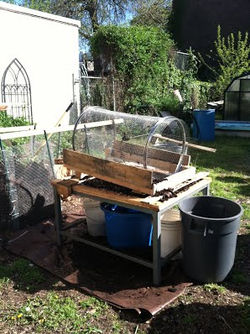 Compost sifter |
 Finished compost |  Compost stages |
 Compost Coop Garden |  Compost Coop Plants |
 Volunteers |  Volunteer work day |
 Volunteers 2 |  Volunteers 3 |
 Volunteers 4 |  Compost pen |
 photo 1 |  Earth Tub Thermostat |
 Site view | 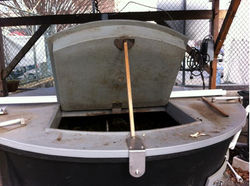 Earth Tub opening |

Survey
I designed a qualitative survey to gauge the interest of my thesis idea and to gather data about what a prototype might look like. I vetted the question design with a faculty member at Philadelphia University and had it reviewed by the Institutional Review Board (IRB) to ensure the methods were ethical.
I limited the survey to seven questions and received a total of 77 responses which also included several open-ended comments. I analyzed the results and obtained data visualizations of the results.
The survey showed a strong interest in the idea of making composting feel more like a game. There were also some suggestions about game dynamics such as cooperative play and a focus on gameplay, not just the external rewards.


Design Charrette


I managed and facilitated a "charrette" style design workshop to get ideas for a game on composting. "Charrettes" are collaborative, interdisciplinary exercises where the users are involved in designing and vetting ideas. It was a great way to get rich feedback about the user's optimisms and cautions about the approach.
The workshop consisted of 20 members which were broken up into four separate teams. Each team was asked to develop as many ideas as possible for designing a game centered on composting. There were two breakout sessions with a set time to vet ideas as a collective group after each one. At the conclusion of the meeting, all of the members were given three sticker dots and asked to put them on the ideas they liked the most. They were only allowed to put one dot on their own concept.
The main ideas that emerged was a need for clear, immediate feedback and an element of competition or some sort of campus contest.
Prototype: The Food Fight
I took all of my research findings to create a prototype of a game on composting for Philadelphia University. I created a low-tech concept using google forms to record data with a linked google sheet with embedded formulas to calculate scores. It's framed as a competition between dorms to see who compost the most based on pounds of food waste collected.
In this version, at least one person would have to manually update the results on a custom WiX page I built but a budget could allow for real-time monitoring.
Some of the key features include:
-
Immediate feedback
-
Social gameplay: dorm competitions, social media, & cooperative school targets
-
Personas and experience levels
-
Visual feedback: CO2 offset visualizations
-
Collaboration and alignment with campus initiatives and sustainability goals.
Full details on all aspects of the design with accompanying research can be viewed in the complete thesis report.


Conclusions
The thesis project stretched me and by the end, I realized just how important it is to research your users and get them involved in the design. I became much more comfortable interviewing people directly and learned a lot in a short amount of time. The project developed in me, a strong sense of agency and initiative to seek out answers quickly as challenges came up.