⚠️ Disclaimer: You are viewing an Archived Portfolio.
You’re viewing work from my early career [2015] - [2021]. To see my most recent work check out my latest work here →

UX Design
"CytoCosmic" is an immune health monitoring system. It is designed to be a handheld device that allows users to check the state of their immune system in a matter of minutes rather than weeks.
The system is minimally invasive and allows you to view results using a smartphone. The accompanying app interprets blood samples and provides suggested action steps.
Challenge
3 Days. 250 People. 26 Teams.

The Jefferson Health Hack is an annual hackathon focused on solving some of healthcare's biggest problems. It brought together people from all different disciplines and walks of life to collaborate together.

The hackathon had a very short turnaround time and the focus was on idea generation and developing a proof of concept. We had the opportunity to create a physical prototype at a makerspace called "NextFab" and I developed a clickable prototype.
The end product provided a strong baseline to iterate from and follow through with more long-term user research.
The following UX deliverables were created:
-
Competitive research
-
User Personas
-
Minimum Viable Product
-
Sketches
-
Prototype
We are CytoCosmic

Pitches and Team formation
After the kick-off on Friday night, we heard people pitch different problem statements. I was intrigued by a pitch that presented the problem with not having a way to monitor immune system health. It was framed as a particular concern for astronauts because their immune systems are known to be lowered due to their extreme conditions.
I really liked how this idea was really "out of the box" and was excited to move forward. By Saturday, we had a team set and refined our the issues.
Our team

Christine Fisher
PhD Microbiology & Immunology
Hui Min Tan
Bioengineer
James Chun
UX Designer
Elizabeth Hall
Arts & Humanities Professor
Samir Khan
Neuroengineer
Ideation
We started by understanding some of the science with the immune system. We decided to focus on measuring certain biomarkers in the blood that are related to an immune system's health including immunoglobulins and white blood cells.
We looked at ways to use fluorophores, a fluorescent chemical compound to attach to targeted bio-markers in the blood. The fluorophores would light up under a microscope when they bind with parts of the cell that are connected with immune health.
Our goal was to develop a way to quickly monitor the immune system without having to deal with long invasive blood tests and prolonged periods of testing. We continued to rapidly iterate on different ideas and researched the work that's been done up to now.


User Personas

62 miles above us
Astronauts above us need a quick way to determine if there any issues with their immune system. Being in space already dampens their system and sending shuttles to analyze blood samples is not feasible.
62 miles west of us
The farmer living out in rural PA lives far from hospitals and labs to do bloodwork. He needs a way to check his immune system from where he is so that he can detect areas of concern.
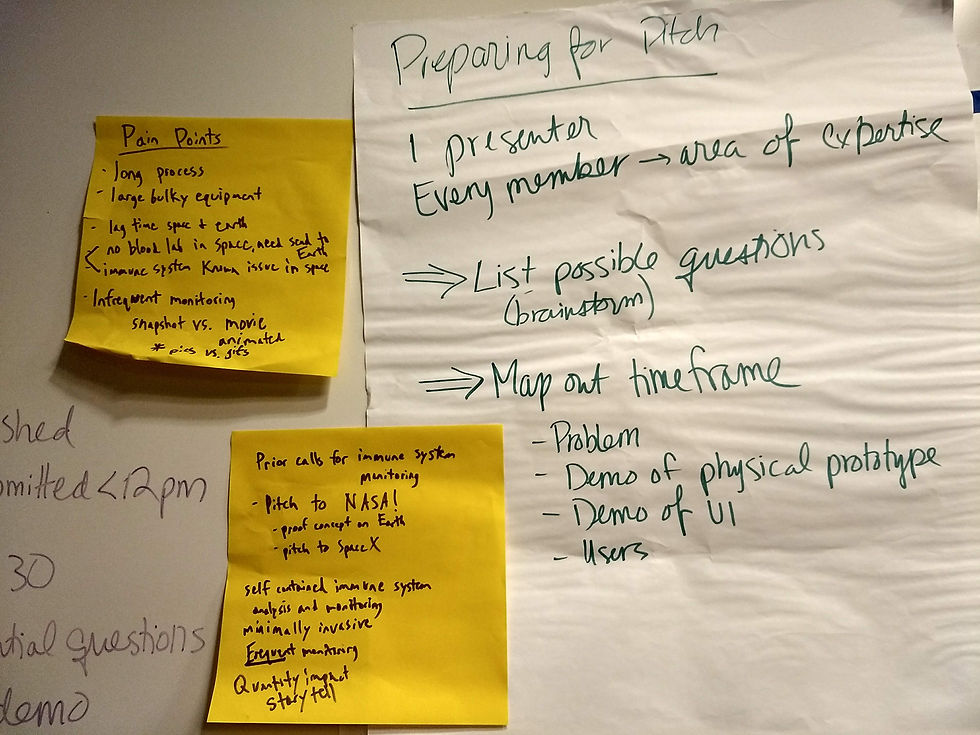
Our team focused on these two primary target users. We are not seeking to replace conventional labs but both groups could benefit from a way to monitor their immune health quickly when access is an issue.
Pain Points
-
Long, invasive blood draws
-
Trouble "finding the vein" leads to discomfort
-
Prolonged lag time for test results
-
Delays from clerical errors in the lab
Minimum Viable Product (MVP)
As an astronaut/remote user, I want to...
-
Diagnose immune disorders to prevent a medical emergency.
-
Keep track of antibody levels so that I can see changes in my immune system over time.
-
Send near real time data about my immune health to medical professionals to address issues.
Sketches
I began to sketch out what some of the user interface screens would look like for our app. We knew we needed the ability to scan blood samples, view results over time, and have some feedback on action steps to take based on the results.


Physical Prototype
Our team had access to a makerspace called "NEXTFAB" to fabricate a physical prototype.
The project included three components:
-
a microneedle patch to draw blood
-
smartphone attachment equipped with a UV light and high power lens to scan the blood
-
accompanying app to read the results
We built a model for the patch and smartphone attachment using simple materials to represent the product.


Style Guide

Prototype
I developed a clickable prototype for the accompanying app to our project. I used the program Figma to design the screens a user would see when scanning their results.
The home screen provides a snapshot of your overall health and shows a history throughout the week. The main feature is with the scan and the app guides users step by step in the process.
The output from the scan shows the state of seven different bio-markers associated with immune health including antibodies, white blood cells, and cytokines. It then shows some action steps to take if there is any concern.
We show another feature where you can track your results historically by week and month. The project has the potential to collect unprecedented amounts of data related to immune health.
Pitch Day

We pitched our idea on Sunday, November 4th before a panel of judges and content experts.
We were quick and to the point about monitoring immune health from anywhere.
After all the teams pitched their projects, everyone came back together for the awards ceremony. We waited anxiously for the results.


And the winners are...


Conclusions
The Jefferson Health Hack was my second hackathon and second win. The organizers did an incredible job of keeping up the energy and excitement of the event. I had an amazing team and we all appreciated each other's skills and backgrounds. These events are memorable for me not only because they have excellent food but they remind me that great things can happen when we come together to solve big problems. See you at the next hack!